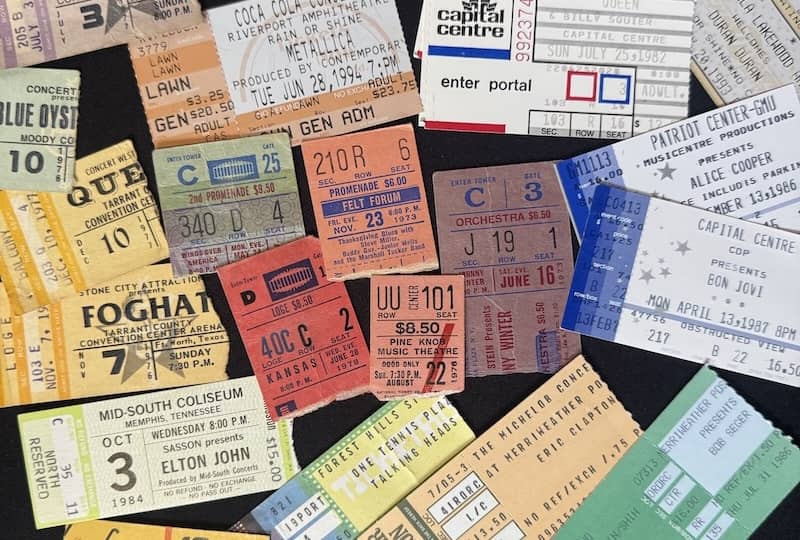
You open a box of old Philadelphia sports ticket stubs and start digging. There’s a Phillies one here, an Eagles one there, and a Flyers stub in between two from the 76ers. Before long, you’ve got a pile from teams and venues all over Philly.
If you’re sorting the collection for resale, it helps to know what you have before deciding which stubs are worth selling. Here’s how to sort through your box and organize your collection before you start looking for ticket stub buyers.

Sort by Team First, Then by Era
Start by separating your tickets into four piles: baseball, football, basketball, and hockey. Then sort each pile by team.
You’ll probably recognize plenty of Phillies, Eagles, 76ers, and Flyers tickets. But keep an eye out for teams that no longer play in Philadelphia, too. The Philadelphia Athletics played baseball in the city before moving to Kansas City after the 1954 season. The Philadelphia Warriors played basketball there before relocating to San Francisco in 1962.
Once you’ve separated the ticket stubs by team, group each pile by decade. You don’t need to put every one in exact chronological order just yet. Start with broad groups. This gives you a better picture of what’s in the collection. You might find dozens of Phillies tickets from the 1970s alongside just a couple from the 1990s. Those groups give you a starting point for further research, but don’t overlook the smaller piles that may contain an unfamiliar team, older ticket, or unusual event.
Use Venues to Place Each Stub in Time
If you can’t clearly see the date or team name on the stub, you can use the venue to help place the stub and team in your timeline. Philadelphia teams have played in several stadiums and arenas, making the venue printed on a stub a useful clue to its era. Here is a rough timeline for each:
- Baseball: The Phillies played at Baker Bowl until 1938, then moved to Shibe Park, which became Connie Mack Stadium in 1953. They moved to Veterans Stadium in 1971 and Citizens Bank Park in 2004. The Athletics also called Shibe Park home.
- Football: The Eagles moved from Shibe Park to Franklin Field in 1958, then to Veterans Stadium in 1971, and finally to Lincoln Financial Field in 2003.
- Basketball and hockey: The 76ers arrived in Philadelphia in 1963 and played at Convention Hall until the Spectrum opened in 1967. The Flyers started in 1967 and also played at the Spectrum. Both teams moved to a new arena in 1996, and that building has carried several corporate names since.
While a venue can help narrow down the era, it doesn’t always help determine the team. For example, Veterans Stadium hosted the Phillies and the Eagles. The Spectrum hosted the 76ers and the Flyers. A stub that shows only the building needs a second clue, such as the opponent or the sport, before you file it.
Ticket designs also changed along with the buildings. Two stubs from the same team can look nothing alike when they are years apart, so don’t judge a stub by whether it matches the one next to it.
Don’t Overlook Regular-Season Stubs
Keep those regular-season tickets. A stub from a random Tuesday night could have included a rookie’s debut, a pitcher’s no-hitter, or a scoring record. Nobody in the stands could have known that they were at a game that would become important, and very few people may have thought to save the ticket stub.
That’s why ordinary dates deserve the same attention as playoff games. Championship games draw a huge crowd, and nearly everyone keeps those stubs. A quiet weeknight game that turned into history leaves far fewer survivors.
Most regular-season games won’t have a major historical story behind them. The point is, only by checking the date and opponent against the record books can you spot the exceptions.
Working With Faded, Torn, and Partial Stubs
A damaged ticket stub can still offer clues about the game it came from. Look for other details that can help you identify it:
- Dates and opponents. Even a month, a day, and one team name can narrow a game down to a handful of possibilities.
- Seat information. Section names and numbering systems can differ from building to building. A seat code could be a clue to the venue. Consecutive seat numbers across several stubs could also suggest that a group watched the game together.
- Printed event details. Words like “opening day,” “playoff,” “doubleheader,” or “exhibition” can tell you what kind of game it was.
Damage doesn’t automatically make a ticket stub unsellable. Start by confirming as many of the three details as you can: the date, the team, and the venue. Even two matching details can help narrow the possibilities. Handwriting on the back may provide another clue, especially if a fan recorded the score or a player’s name.
Take Stock of Your Philadelphia Ticket Collection
Your sorted collection now reads like a timeline. It shows which teams someone followed, which stadiums they visited, and how ticket designs changed over the decades.
If you plan to sell your Philadelphia ticket stub collection, keeping similar tickets together makes them easier to photograph and research. Photograph the front and back of each stub, and check that the date, team, and venue are legible.
Set aside any stub tied to a personal memory that you’d hate to let go of, like a first game with a parent or a night you still talk about. Those can stay with you, no matter what the market says.