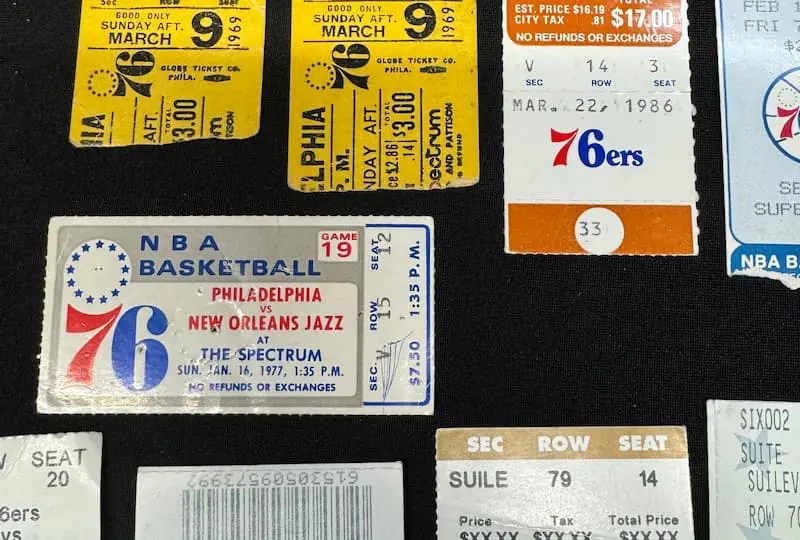
Imagine you’re going through your dad’s ticket stub collection. You see one from an AC/DC concert in 1985, another from a Bulls game during Michael Jordan’s tenure, and one from an Alanis Morrisette concert in 1996. You think that these have got to be worth some money, so you turn on your computer and search “how much is my old ticket stub worth?”
This ticket stub price guide walks through what actually determines value, sport by sport and category by category, rather than pretending that one figure could ever cover it all. Two tickets from the same team, the same year, even the same section of the same stadium can land worlds apart in price, because value seldom comes down to age alone.
Why There Is No Universal Price Chart
If you see a chart claiming that every 1980s baseball ticket is worth $10 and every 1990s concert ticket is worth $25, you should ignore it. In reality, a single regular-season game from any given year could be worth $5 or $5,000, and nothing printed on the ticket itself gives that away.
Because of that type of dollar range, it may seem like pricing in this hobby is impossible. It isn’t; the value of a stub depends on unique factors that don’t fit into a formula.
The 4 Factors That Drive Value
Four things determine what a stub is worth, and none of them may show up on a generic chart.
- What happened at the event: A record, a milestone, a recorded performance, or a moment tied to something people still talk about is what creates demand in the first place.
- How many stubs survived: A famous night that a huge crowd attended, where most people knew to keep their ticket, spread the demand across a large supply. A quiet night that almost nobody thought to protect concentrates the same demand onto a smaller pool.
- Who wants it: Some collectors chase anything tied to one team or artist. Others want a specific date and nothing else. Both kinds of demand exist side by side, often for different reasons.
- Condition (to a smaller degree): A torn, faded, or handwritten-on stub can outsell a pristine one, since it proves someone was actually there. The condition premium in this hobby is sometimes much smaller than it is in other areas of collecting.
The category breakdown below shows how these four factors tend to play out differently across sports and genres. However, the same four rules generally apply to all of them.
What Each Category Tends to Look Like
Some categories turn up surprises more often than others, mostly because of how many tickets survive and how well their histories have been documented.
Baseball Ticket Stubs
Baseball makes up the largest share of what we see, and most of it predates 2000. The typical vintage baseball stub submission is an ordinary regular-season game, and most of that is worth a modest amount.
The exceptions tend to be specific. Events like a no-hitter, a milestone hit, a rookie debut that turned into a Hall of Fame career, or a strange in-game incident nobody could have scripted are all usually tied to a higher value. A rookie’s first big-league appearance can look like nothing on the stat sheet at the time and still end up worth thousands of dollars once someone connects it to what that player became.
Basketball Ticket Stubs
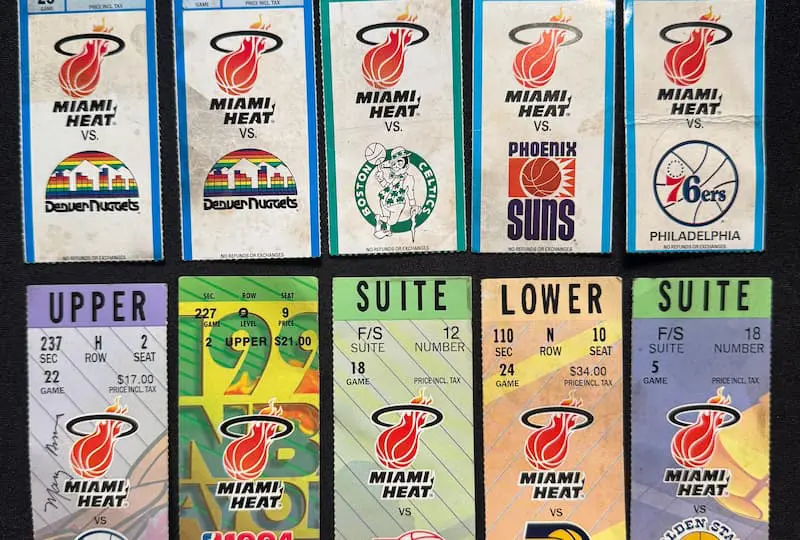
Basketball follows the same story-driven logic, sometimes taken to an extreme. A player’s first professional game, before anyone outside the league knew their name, can end up worth far more than a stub from that same player’s championship run years later. This is usually because almost nobody thought a rookie debut was worth saving a ticket for, which makes the surviving tickets rarer.
Even though most basketball stubs are unlikely to reach a particularly high value, the principle still holds. Events like a debut, a record, or a specific memorable moment on the court matter more than the fact that basketball was being played at all.
Football Ticket Stubs
Regular-season and playoff football tickets work the same way as baseball. A season opener for a brand new franchise, a record-setting performance, or an unremarkable-looking game that turned out to be the first appearance of a future star tends to matter more than the specific teams or year.
Super Bowl tickets are the exception…
Super Bowl Ticket Stubs
Super Bowl tickets are the category many people assume is most valuable. That’s not always the case. A Super Bowl fills a stadium with roughly 80,000 people. In the moment, nearly all of whom understand they are watching something memorable. That collective instinct to hold onto the ticket is exactly why so many stubs survive from any single game, and exactly why it often limits the potential selling price.
There is also an authenticity issue specific to this category. Over the years, the NFL has released commemorative Super Bowl tickets that carry the same hologram as a genuine ticket but were never used to attend the actual game. It is one more reason a stub is worth having checked by someone who knows what to look for, rather than judged on appearance alone.
Hockey Ticket Stubs
NHL tickets come through far less often than baseball, basketball, or football, mostly because the sport has a smaller fan base and fewer surviving stubs in general circulation. However, that relative scarcity does not automatically translate into higher value. A hockey stub still needs a documented connection to something specific, not just a smaller print run, before it is worth real money. Wayne Gretzky’s October 10, 1979, NHL debut for the Edmonton Oilers against the Chicago Black Hawks is a good example. Only 18 authenticated stubs from that game are known to survive, and the highest-graded one sold at auction for an estimated $80,000 or more.
Wrestling Ticket Stubs
These come up occasionally, and the same logic applies here, too. A milestone event or a card tied to a specific storyline moment tends to carry more weight than an ordinary house show. This is a newer category in the hobby, so established values are less consistent here than they are in baseball, basketball, or football. One particular stub from WrestleMania I at Madison Square Garden in 1985 sold for just over $4,100 in 2025, and other surviving stubs from that show sold for similar four-figure prices.
Olympic Ticket Stubs
Olympic tickets are even less common. A specific event tied to a record, an upset, or a moment that became historic afterward carries more weight than a routine qualifying heat, no matter which Olympics it came from. A stub from the 1936 Berlin Games, specifically the August 9 track-and-field session when Jesse Owens won his fourth gold medal of that Olympics, sold at auction for $750.
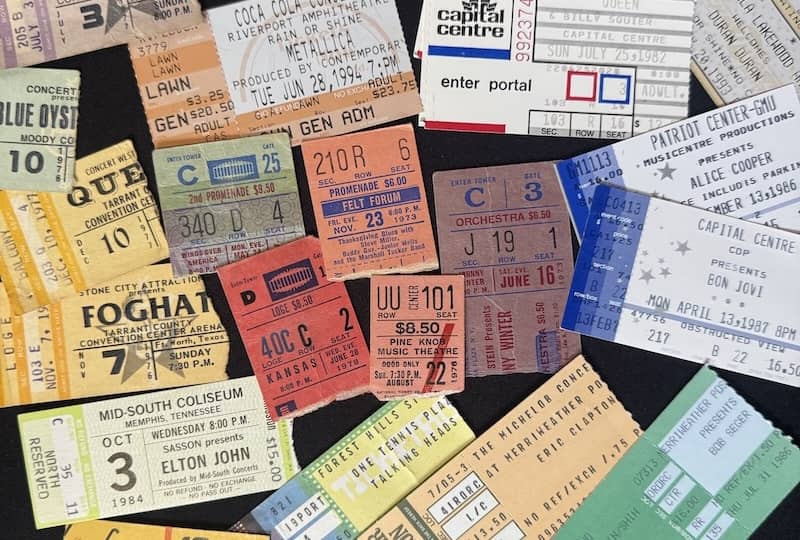
Concert Ticket Stubs
Roughly a third of the collections we see are concerts only, and the pattern mirrors sports. A show that was professionally recorded, a performance from an act’s mostly unknown years, or a night that turned into an unplanned spectacle tends to outvalue a headline act playing an ordinary tour stop. A small club show by a band that later filled arenas is a good example of the general rule. Fewer people bothered to keep a ticket because almost nobody there had a reason to think it would matter.
The Death of the Ticket Stub
Starting around 2010, most venues began fading out physical ticket stubs in favor of digital ones, which were easier to send and validate. You might be able to get a stub printed at the venue if your phone battery is dead. Generally, though, most are online via apps, barcodes, or QR codes. And some events offer collector’s tickets as an upgrade at checkout so that you can have memorabilia from the event. There are even some platforms like Etsy or Stubforge where you can request a custom stub made for your event after the fact. However, these are usually more for display only and aren’t real ticket stubs. Who knows if collector’s tickets that never saw the event itself will be worth money in the future?
The Only Way to Really Know
None of these categories reduces to a single number, and that’s exactly what makes this hobby interesting in the first place. A ticket’s value comes down to a specific piece of history, not the sport, the artist, or the decade printed on it. A stub sitting in a box somewhere could be worth far more than it looks.
The only reliable way to find out is to have it checked against real historical research instead of a generic chart. A legitimate buyer can do that quickly and for free, with no obligation to sell. That ordinary-looking ticket might turn out to be exactly the kind of story this whole guide has been about.